

Traditional ecommerce platforms still treat high-risk catalogs as second-class merchants: surprise account holds, restricted payment processors, and storefront takedowns that wipe out months of work overnight. A growing number of sellers are looking for a serious high-risk ecommerce alternative that keeps orders, payments and customers in the same channel instead of scattered across a Shopify dashboard, a Stripe inbox and a WhatsApp thread. Telegram is quietly becoming that channel — purpose-built around chat, bots and lightweight payments, it removes the friction that pushes restricted-product sellers into chargeback spirals.
Why traditional ecommerce keeps failing high-risk sellers
Mainstream storefronts are optimized for low-risk SKUs: t-shirts, books, branded mugs. The second a catalog touches cannabis accessories, peptides, supplements, vape hardware, adult products or anything labeled “restricted”, the underwriting model starts pushing back. Card processors raise reserves, hosting providers issue takedown notices, and ad platforms ghost the merchant account. The seller did nothing wrong — the rails were never built for them.
The result is a fragmented stack: a Shopify store that may disappear next week, a payment provider that may freeze funds, a customer-service inbox no one reads, and a community on Telegram or Discord where the actual buying conversations already happen. Why high-risk sellers are moving to Telegram instead of traditional ecommerce goes deeper into the economics, but the short version is simple: the audience is already there, and the channel is harder to deplatform than a hosted store.
What makes Telegram a real high-risk ecommerce alternative
Telegram is more than a chat app. With bots, in-chat checkout, channels and groups, it covers the same job-to-be-done as a traditional storefront — discover a product, place an order, pay, get support — while staying inside a conversational interface buyers already trust. For high-risk verticals, that conversational layer is a feature, not a workaround: it lets sellers verify intent, answer questions privately, and confirm shipping details before money moves.
Compared to legacy hosted shops, Telegram-first commerce strips out three sources of failure for restricted catalogs: hostile payment underwriting, public storefront enforcement, and ad-platform bans. The trade-off used to be tooling — but that gap has closed. Side-by-side, Telegram Shop vs Shopify for small businesses shows that small teams can run a full catalog, repeat-buyer flow and abandoned-checkout recovery without ever touching a hosted theme.
Orders, payments and customer messages in one channel
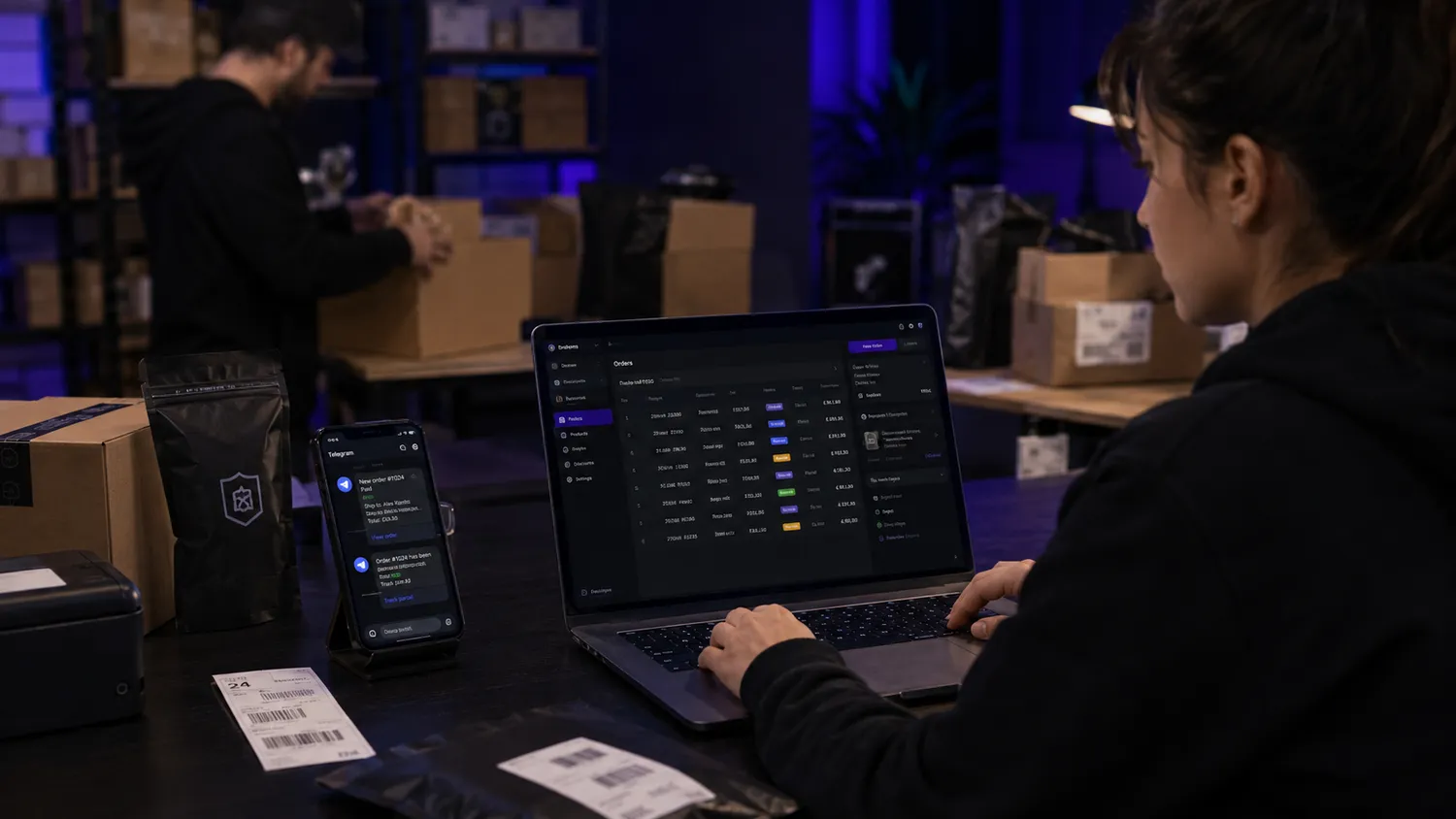
The reason this high-risk ecommerce alternative sticks is consolidation. In a Telegram-native flow, the buyer browses an in-chat catalog, taps “Buy”, confirms quantity, pays through the same window, and receives tracking updates in the thread they already have open. The seller sees the order, the payment status and the customer’s chat history side by side — no tab-switching, no exporting CSVs, no “where did this DM go”.
Telegram payments for high-risk products: how the money moves
Payments are where most high-risk merchants get burned on Shopify or WooCommerce. Telegram supports its own payment integrations plus invoice bots, crypto rails and off-platform links, which gives sellers room to combine providers and route around bans. The practical answer to “can I actually accept payments here” is yes — with caveats around verification and refunds that the Telegram payments for high-risk products guide unpacks in detail.
Three patterns work well for restricted catalogs:
- Hybrid checkout: a default card processor for compliant SKUs plus a crypto fallback for the restricted line.
- Invoice-first: the bot generates a one-time invoice the buyer pays from their wallet, then ships only after confirmation.
- Manual confirmation: for very high-value or compliance-heavy orders, the seller verifies inside the chat before releasing inventory.
Security and trust: protecting a high-risk ecommerce store on Telegram
A common objection is “isn’t Telegram less secure than a real shop?” In practice, it’s the opposite. A Telegram store moves authentication onto the buyer’s verified account, hides the seller’s hosting infrastructure, and uses bot tokens that can be rotated instantly. Combined with rate limits, admin roles and audit logs, the stack is harder to phish than a typical WooCommerce admin. The full hardening checklist lives inside Telegram Shop security, but the core principle is the same: separate the bot, the payments and the catalog so a compromise in one layer doesn’t cascade.
What buyers actually see during a purchase
From the buyer’s side, the high-risk ecommerce alternative looks like a normal chat: a catalog button, product cards, an in-chat invoice and a confirmation message. Nothing about the experience telegraphs “this is a restricted product” — which is exactly what compliance-friendly merchants want. Inside the Telegram sales flow for restricted products walks through the exact screens and the friction points to remove.
Migrating from a traditional store to a Telegram-first setup
Sellers don’t have to abandon their existing site to adopt this channel. The pragmatic migration path is layered: keep the marketing pages, point conversion traffic to a Telegram bot, and let the bot own the order, the payment and the post-sale chat. Over a few weeks, the share of revenue flowing through Telegram usually overtakes the legacy storefront — at which point the storefront becomes a content site, not a checkout.
Signals it’s time to switch
- Recurring payment-processor holds or reserve increases.
- Storefront takedowns, theme rejections or app-store removals.
- Most repeat buyers already DM you instead of using the cart.
- Customer support load that no helpdesk template can keep up with.
- Ad accounts banned faster than you can spin up new ones.
The honest checklist before you commit to a Telegram-first store
Picking a high-risk ecommerce alternative isn’t a vibe decision — it’s a stack decision. Before you migrate, walk through the five checks below. If you can answer “yes” to four of them, Telegram is almost certainly a better home for your catalog than the platform you’re on right now.
- Audience presence: are your repeat buyers already in Telegram channels or DMs?
- Payment resilience: do you have at least one non-card payment rail (crypto, invoice, manual) ready to plug in?
- Catalog clarity: can you describe each SKU in a single product card with one photo and one price?
- Support reality: are most of your tickets already chat-shaped questions, not phone calls or formal emails?
- Compliance comfort: can you operate within Telegram’s terms and your local law without grey-area workarounds?
If that list reads like your business, the channel switch is overdue. Spin up a Telegram store with Trapyfy — a Telegram-native storefront builder for high-risk catalogs — plug in your products and payment rail, and let the bot do what your old storefront couldn’t: keep orders, money and conversations in one place, without the threat of a Monday-morning email saying your account has been suspended.
Frequently asked questions about high-risk ecommerce on Telegram
Is Telegram really a viable high-risk ecommerce alternative for a small team?
Yes. A two-person team can run a full catalog, payments and support from a single bot — the operational overhead is closer to managing an inbox than running a hosted store, and there’s no theme, plugin or processor risk hanging over the business.
Can I accept card payments for restricted products on Telegram?
For most fully restricted categories, no card processor will underwrite the volume — but Telegram lets sellers combine compliant card rails for legal SKUs with crypto or invoice rails for the restricted line, so the channel stays open without breaking processor terms.
How is moderation handled compared to traditional ecommerce?
Telegram moderates based on public abuse signals, not catalog crawls of private bots. Provided the seller respects local laws and Telegram’s terms, restricted-but-legal catalogs operate with far less arbitrary takedown risk than on Shopify, Etsy or WooCommerce.
What does a typical high-risk Telegram order flow look like?
Buyer opens the bot, browses the catalog, taps a product, confirms quantity, pays through the in-chat invoice, and gets a tracking update inside the same thread. The seller reviews the order in the admin panel and ships — no separate checkout page, no email chain.
Do I lose SEO if I move my high-risk store to Telegram?
No, because the discovery layer stays on the open web. Sellers keep their blog and landing pages indexed in Google, then funnel intent traffic into the Telegram bot for the actual transaction. SEO and the bot work as a pair, not as substitutes.